Estimated Reading Time: 8 minutes
The short version: The minor servicing exception in OSHA’s lockout/tagout standard lets you service equipment during normal production without full LOTO, but only when four conditions are met at once. The task has to be routine, repetitive, and integral to production, and you have to use alternative measures that provide effective protection. Miss any one of those, or reach into the danger zone unprotected, and full lockout/tagout is required.
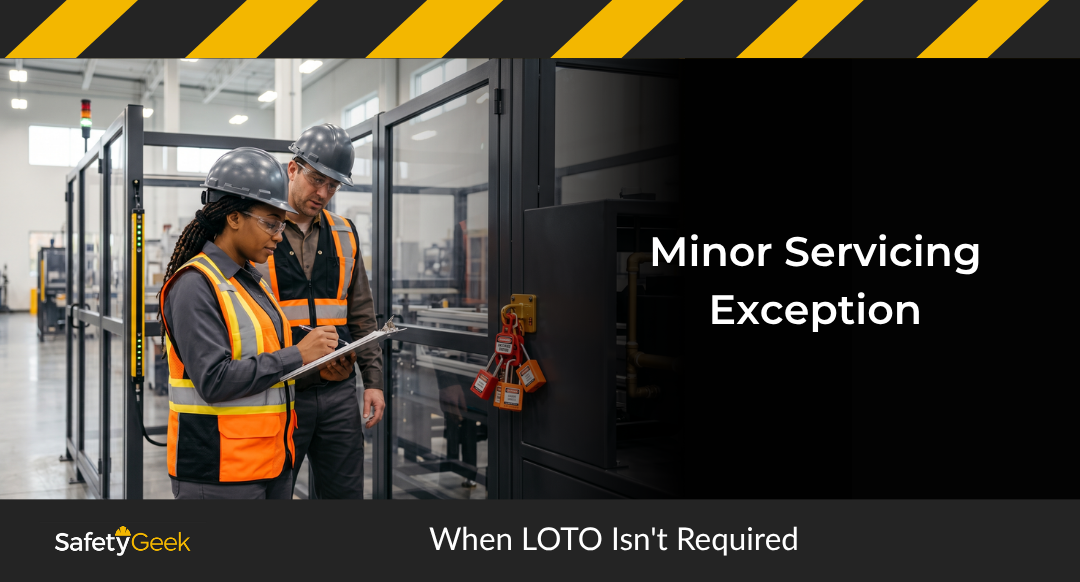
The minor servicing exception is the narrowest, most misunderstood corner of OSHA’s lockout/tagout rule. It lets you perform small servicing tasks during normal production without locking out the machine. But it only applies when the task is routine, repetitive, integral to production, and protected by alternative measures that actually work.
Here’s where it gets dangerous. A lot of safety leads inherit a shop floor where “it takes two seconds, just reach in and clear it” has been the unwritten rule for years. You know that feels wrong… but you’re not always sure where the legal line sits, and you don’t want to be the one who shuts down production over a jam that clears in five seconds.
So let’s draw that line clearly. OSHA’s control of hazardous energy standard hands you an exception here, not a loophole, and the gap between those two words is exactly where people get hurt.
Key Takeaways
- The minor servicing exception lives in 29 CFR 1910.147(a)(2)(ii). It’s an exception, not a workaround.
- All four conditions have to be true at the same time: routine, repetitive, integral to production, plus effective alternative protection.
- “Quick” is not one of the conditions. A two-second task can still require full lockout/tagout.
- The second a body part enters the danger zone without effective protection, the exception is gone.
- Setup, changeover, and major cleaning are servicing… they are never “normal production.”
- Alternative measures have to be engineered protection, not a policy that says “be careful.”
What the Minor Servicing Exception Actually Is
A minor servicing exception is a specific carve-out in OSHA’s lockout/tagout standard for small tasks that happen during normal production. It sits in 29 CFR 1910.147(a)(2)(ii), and OSHA wrote the language tight on purpose.
The standard says lockout/tagout does not cover “minor tool changes and adjustments, and other minor servicing activities” during normal production… but only if they are routine, repetitive, and integral to the use of the equipment for production, AND the work is done using alternative measures that provide effective protection.
Read that twice. It isn’t “small jobs are exempt.” It’s a four-part test, and the rule is built so that every part has to pass before the exception means anything.
I’ve watched this carve-out get stretched into something it was never meant to be. A maintenance tech pops a guard to free a stuck part “real quick,” and everyone treats it as covered because it was fast. It isn’t. Speed was never the standard. The exception protects a narrow set of production tasks, and the whole point is that the worker is never exposed to the hazardous energy the rule exists to control. OSHA’s lockout/tagout eTool walks through the same logic if you want to see it laid out by the agency.
The Four Conditions Every Task Has To Meet
Every task you want to run under the exception has to clear all four bars below. Not three. Not “mostly.” All four, every single time.
Routine means a regular course of procedure done the same established way. Repetitive means it repeats as a normal part of the production cycle. Integral to production means the task is built into running the machine for its intended job, not a repair that stops production. And alternative measures that provide effective protection means engineered safeguards keep the worker out of the hazard while the task happens.
| What you’re checking | Exception can apply | Full LOTO required |
|---|---|---|
| Timing | During normal production | Setup, changeover, major repair |
| Scope | Minor adjustment, lube, small jam | Disassembly, troubleshooting in the hazard zone |
| Pattern | Routine and repetitive | One-off or unpredictable |
| Protection | Engineered alternative measures | “Be careful” or stop button only |
| Body exposure | Stays out of the danger zone | Hand or arm enters point of operation |
Notice that “how long it takes” is not a row in that table. OSHA has said plainly that short duration alone does not make a task minor. If you’re leaning on “but it only takes a second” to justify skipping lockout, you’re leaning on the one thing the rule doesn’t care about.
Misreading this exception drives some of the most common LOTO violations OSHA cites year after year. And it’s why I tell safety leads to stop thinking machine-by-machine. The same press can have one task that qualifies and another that demands full LOTO an hour later. The exception attaches to the task, never to the equipment.
THE ALL-ACCESS PASS RESOURCE PAGE
Get all the FREE templates, safety management resources, PDFs, spreadsheets, and more...
The Danger Zone Is the Hard Line
If there’s one sentence to tattoo on this whole topic, it’s this: nobody puts a body part in the danger zone while the machine can move, unless effective alternative protection has completely removed the hazard.
OSHA states it directly in its 1999 letter of interpretation. A worker is never permitted to place any part of the body into a hazardous area like the point of operation or an ingoing nip point while the equipment is energized… unless they’re doing qualifying minor servicing AND alternative measures that provide effective protection are in place.
So the field test is simple. If the task forces a hand, an arm, or a head into the point of operation, the ingoing nip point, or near power-transmission parts, and the energy isn’t fully controlled by an engineered safeguard, you’re past the exception. That’s full lockout/tagout, full stop.
Bypassing or defeating a guard to reach the work ends the conversation immediately. The moment that guard comes off for access, OSHA treats it as servicing covered by the standard. I’ve seen this exact pattern in real LOTO incidents… a “quick” reach-in, an unexpected cycle, and a life changed in under a second. Contact with machinery stays one of the leading sources of serious injury in BLS injury data, and uncontrolled energy during servicing is a big slice of it.
What “Effective Protection” Really Means
This is the condition employers fumble most. “Alternative measures” does not mean training, signage, or a promise to be careful. It means engineered protection that keeps the worker out of the hazardous energy, verified to actually do it.
OSHA and ANSI point to safeguards like these:
- Interlocked barrier guards that stop the machine the instant they’re opened.
- Presence-sensing devices like light curtains or area scanners, built with control reliability so the machine can’t cycle while someone’s in the zone.
- Two-hand controls, or controls placed far enough from the hazard that the operator can’t reach in while it runs.
- Remote tools like remote oilers or clearing rods that do the job without a hand ever entering the danger zone.
- Control-reliable safety circuits designed so a single component failure can’t strip away the protection.
In a 2004 OSHA interpretation, the agency confirmed that control-reliable safety circuits designed to recognized standards can serve as acceptable alternative safeguarding for tasks that otherwise qualify. The key word is reliable. A plain start/stop button, a selector switch, or a line of PLC code on its own does not clear the bar.
Here’s the gut check I give my teams. If the worker could still get hurt by an unexpected movement or a release of stored energy, the alternative measure isn’t effective… and you’re right back to lockout/tagout.
How To Decide, Task by Task
The cleanest way to handle this exception is to build the decision into your systems before anyone’s standing at a jammed machine. This is where the Safety Management Cycle earns its keep, because you can settle the question during Identify and Develop long before Coach and Observe.
Start by identifying every routine task people actually do during production… the jam clears, the lube points, the small adjustments. Pull them straight out of the job hazard analysis for each task, because the JHA is where these calls belong. A task-based JHA tells you exactly where a hand goes and what energy is live.
Then develop the decision for each one. Does it pass all four conditions with engineered protection, or does it need full LOTO? Write that answer down where the operator and supervisor can both see it, and make the qualifying alternative measures part of the procedure, not floor folklore.
One more thing safety leads forget… you don’t own enforcement of this on the floor. The front-line supervisor does. Your job is to be the guide on the side: build the analysis, train the call, and make the safe way the obvious way. When the decision is already made on paper, nobody’s improvising over a running machine. And if more than one person services the same equipment, you’re into group lockout/tagout procedure territory, which is its own animal.
If your energy control procedures are thin or missing, fix that first. A solid lockout/tagout program is what turns the minor servicing exception into a usable rule instead of a guessing game.
Frequently Asked Questions About the Minor Servicing Exception
Is there a time limit on the minor servicing exception?
No. OSHA sets no time limit, and it has stated that short duration alone never makes a task qualify. A job that takes two seconds can still require full lockout/tagout if it isn’t routine, repetitive, and integral to production with effective alternative protection in place.
Does the exception apply to clearing a jam?
Sometimes, but only if clearing that jam is a routine, repetitive part of production and the worker never enters the danger zone unprotected. If clearing it means opening a guard or reaching into the point of operation with energy live, it’s full lockout/tagout, not minor servicing.
Can a stop button or e-stop count as alternative protection?
On its own, no. A standard start/stop button, selector switch, or emergency stop is not an engineered safeguard for this purpose. Acceptable alternative measures are things like interlocked guards, light curtains, or control-reliable safety circuits that keep the worker clear of the hazard.
Does the exception cover setup and changeover?
No. OSHA treats setup, changeover, die changes, and major cleaning as servicing, not normal production. Those tasks fall under full lockout/tagout every time, no matter how routine they feel to your crew.
Who decides whether a task qualifies?
You build the analysis, but the call lives in your written procedures and JHAs, not in an operator’s head at the machine. Decide ahead of time, document the alternative measures, and let supervisors hold the line. When in doubt, treat it like any of the tougher LOTO questions and default to control.
Now It’s Your Turn
The minor servicing exception isn’t a blanket pass to skip lockout/tagout. It’s a narrow, four-part test, and the safest safety leads treat it that way… they decide on paper, not at the machine.
Here’s where to start this week:
- Walk one production line and list every “quick reach-in” task people actually do.
- Run each one through the four conditions: routine, repetitive, integral, effectively protected.
- Flag any task that needs a guard removed or a hand in the danger zone. Those are full LOTO.
- Write the call into the JHA so the operator and supervisor see the same answer.
Do that, and you turn a fuzzy “it’s only a second” habit into a clear standard your team can trust. Want the procedures and checklists to build this out? Grab the energy control templates from the All-Access Resources above… they’ll save you from starting at ground zero.
You’ve got this. I’ve got you, Safety Friend.
Hi, I'm Brye (rhymes with sky)! I am a self-proclaimed safety geek with two decades of general industry safety experience. Specializing in bringing safety programs to a world-class level and building a safety culture, I have trained and coached many safety managers, just like you, on how to effectively manage workplace safety in the real world. I would love to help you too.