Estimated Reading Time: 10 minutes
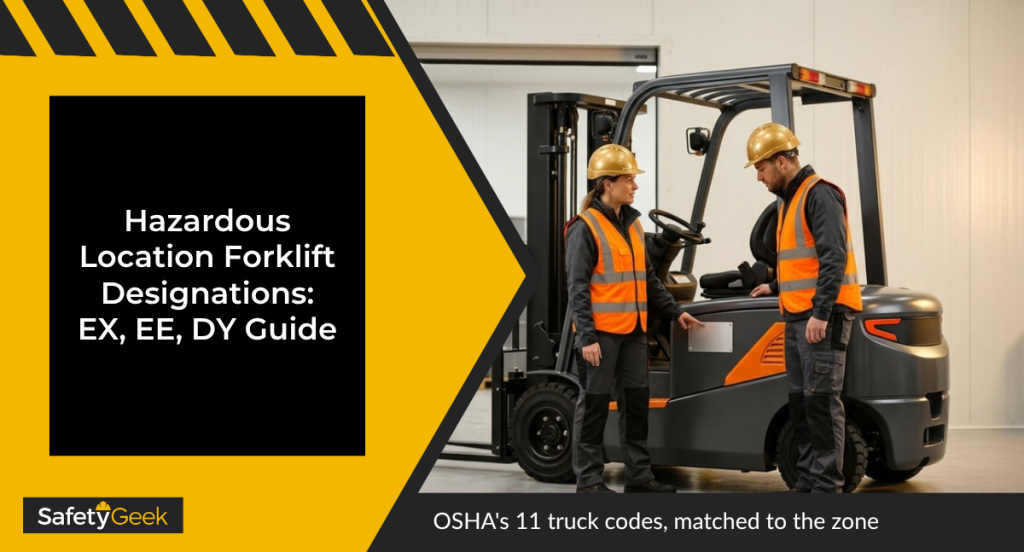
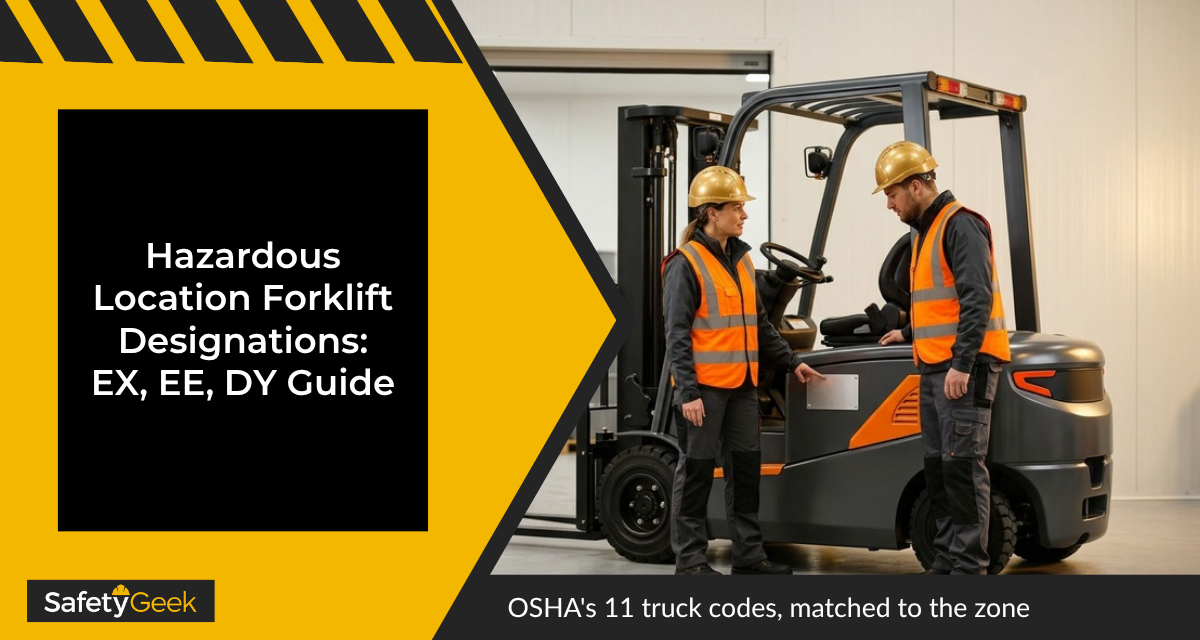
Hazardous location forklift designations are the letter codes OSHA uses to say which trucks can safely enter a classified area. EX trucks are built for flammable vapors and dusts, EE trucks fully enclose every electrical part, and DY diesels carry no electrical equipment at all. You classify the area first, then match the truck to it using 29 CFR 1910.178(c) and Table N-1.
Hazardous location forklift designations tell you whether a truck can run where flammable vapors, combustible dust, or ignitable fibers are present. Where flammable vapors or dust are in the air during a normal shift, that means an EX truck…and in a few atmospheres, no truck at all.
The truck you bought for the paint room was right. But what about the rental that showed up during a breakdown?
Put a standard E truck where gasoline vapor is present on a normal shift, and you’ve driven a spark source into the exact air the classification warns you about.
Purchasing won’t always call you before they sign that rental lease. So this check has to live somewhere they’ll hit it, every time.
Key Takeaways
- OSHA recognizes 11 truck designations in 1910.178(b), and only 3 of them (EX, EE, and DY) are built for the tougher hazardous locations.
- The area has to be classified before you choose the truck. OSHA says so directly in 1910.178(b)(12).
- EX is the only designation allowed where flammable vapors or dust are in the air during normal operations.
- Some atmospheres allow no powered truck at all, including acetylene, hydrogen, and ethylene oxide.
- The approval only holds while the truck stays as built. No repairs inside classified areas, no unapproved modifications, and the testing lab label has to stay on.
- Classification, purchasing, maintenance, and daily inspections all have to point to the same drawing, or the wrong truck finds its way in.
What Hazardous Location Forklift Designations Mean
A forklift designation is a code that describes how much fire protection is built into a truck’s fuel and electrical systems. The first letter is the power source: D for diesel, E for electric, G for gasoline, and LP for liquefied petroleum gas. The letters after it tell you how many extra safeguards the manufacturer added.
Think of it like the rating on a fire extinguisher. An ABC label tells you which fires it’s built for, and you’d never grab a water extinguisher for a grease fire just because it was closer.
The 11 Designations in Plain English
OSHA’s powered industrial truck standard lists all 11 in paragraph (b). Here they are side by side.
| Designation | Power | What it adds |
|---|---|---|
| D | Diesel | Basic fire safeguards only |
| DS | Diesel | Extra safeguards on exhaust, fuel and electrical systems |
| DY | Diesel | Everything in DS, no electrical equipment including the ignition, plus temperature limits |
| E | Electric | Basic fire safeguards only |
| ES | Electric | Extra safeguards to stop hazardous sparks and limit surface temperatures |
| EE | Electric | Everything in E and ES, with motors and all electrical equipment completely enclosed |
| EX | Electric | Electrical fittings and equipment built for certain flammable vapor or dust atmospheres |
| G | Gasoline | Basic fire safeguards only |
| GS | Gasoline | Extra safeguards on exhaust, fuel and electrical systems |
| LP | LP gas | Basic fire safeguards only |
| LPS | LP gas | Extra safeguards on exhaust, fuel and electrical systems |
Why EX, EE and DY Are the Ones That Matter
The DS, ES, GS, and LPS trucks handle storage areas where hazards only show up if something breaks. EX, EE and DY are the trucks OSHA names for the tougher spots, like dust that settles on equipment, fiber processing areas, and rooms next to a Class I, Division 1 zone.
EE seals the electrical parts inside enclosures, and DY’s answer is simpler…no electrical equipment at all, not even the ignition. EX has its fittings and equipment built for the specific vapor or dust atmosphere it’s rated for, which is why you check that rating against the room.
You can run a better-protected truck than the zone needs. Paragraph (c)(1) lets you run a truck with more safeguards than the location requires. So an EX truck can generally work where an EE truck is allowed (just confirm its rating covers that atmosphere).
It NEVER works the other way around.
Classify the Area Before You Pick the Truck
OSHA requires the location to be classified as hazardous or nonhazardous before anyone considers which truck to use there. That’s 1910.178(b)(12), and it’s the step people skip when a rental shows up during a breakdown or purchasing finds a better deal.
Class, Division and Group in Plain English
Hazardous location classification comes from the electrical side of OSHA’s rules, in 1910.307 for hazardous (classified) locations. It answers 3 questions about the air in a room.
- Class is what’s in the air. Class I is flammable gas or vapor, Class II is combustible dust, and Class III is easily ignitable fibers or flyings.
- Division is how often it’s there. Division 1 means the hazard is present during normal operations. Division 2 means it only shows up when something goes wrong, like a punctured drum or a failed exhaust fan.
- Group is the specific material, because hydrogen, gasoline, and grain dust all ignite differently.
Your facility’s classification should come from someone qualified, usually an engineer working from the electrical code and your process data. If nobody can find that drawing, finding it (or getting it done) is your first project.
What OSHA’s Location Rules Say
Paragraph (c)(2) spells out which designations OSHA allows in each kind of location. This is the part worth printing and posting at the doorway of every classified area, where operators, maintenance, and the rental driver will actually see it.
| Location | Trucks OSHA allows |
|---|---|
| Not classified as hazardous | D, E, G or LP (or any truck with more safeguards) |
| Sealed containers of flammable liquids or compressed gas in storage | DS, ES, GS, or LPS |
| Flammable liquids or gases normally kept in closed systems, ventilation-controlled rooms, or areas next to a Division 1 zone. | DY, EE or EX |
| Flammable vapors like gasoline, propane, acetone, or alcohol present during normal operations | EX only |
| Combustible dust in the air during normal operations, like grain handling or grinding rooms | EX only |
| Combustible dust that settles on surfaces but isn’t normally in the air | DY, EE or EX |
| Ignitable fibers being processed or manufactured | DY, EE or EX |
| Ignitable fibers in storage only | DS, DY, ES, EE, EX, GS or LPS (E trucks already used there can stay) |
Metal dust, carbon black, coal and coke dust get even tighter rules. Only approved EX trucks can go in, and where magnesium or aluminum dust is present, the truck’s fuses, switches, and controllers need enclosures approved for that location.
The Places No Forklift Can Go
Some atmospheres are off-limits to every powered industrial truck. Paragraph (c)(2)(i) bans them where there are hazardous concentrations of acetylene, butadiene, ethylene oxide, hydrogen, propylene oxide, acetaldehyde, cyclopropane, diethyl ether, ethylene, isoprene, or unsymmetrical dimethyl hydrazine.
OSHA’s 1995 letter on Class I, Group C locations adds one more wrinkle. Table N-1 doesn’t authorize any truck for Group C at all.
In OSHA’s table, Group C is the ethyl ether family, while gasoline, acetone, and alcohols sit in Group D.
The outright ban still covers hazardous concentrations of every chemical in (c)(2)(i), diethyl ether included.
For the rest of Group C, OSHA will accept a later edition of National Fire Protection Association (NFPA) standard 505 where its table actually says a truck type is authorized. But only if a nationally recognized testing lab lists the truck and it carries the label to prove it.
THE ALL-ACCESS PASS RESOURCE PAGE
Get all the FREE templates, safety management resources, PDFs, spreadsheets, and more...
EX vs EE vs DY: Matching the Forklift Designation to the Zone
So what is the air doing during a normal shift? If the hazard shows up during normal work, even off and on, you need EX. If it only shows up when a closed system or a ventilation fan fails, EE or DY may do the job.
| Question | EX | EE | DY |
|---|---|---|---|
| Power source | Electric | Electric | Diesel |
| How it controls ignition | Built for the specific vapor or dust atmosphere | Fully enclosed motors and electrical equipment | No electrical equipment, plus temperature limits |
| Flammable vapors present during normal operations | Yes | No | No |
| Combustible dust in the air during normal operations | Yes | No | No |
| Settled dust, fiber processing, or areas next to Division 1 | Yes | Yes | Yes |
| Exhaust to manage indoors | No | No | Yes |
When EX Is the Only Answer
If gasoline, propane, solvents, or alcohol vapors are present during normal work, OSHA allows only an approved EX truck. Paint mixing rooms, solvent dispensing area,s and fuel transfer operations often land here.
The same goes for grain elevators, flour and starch plants, and rooms with grinders, pulverizers, or open conveyors throwing dust into the air.
Where EE and DY Fit
EE and DY trucks cover the middle ground. Think flammable liquids that stay in closed piping, a room where fans keep vapors down, or a warehouse aisle next to a Division 1 room.
DY trucks bring exhaust and carbon monoxide into the picture, so they’re a tougher fit for enclosed buildings. That’s one more reason to talk through the whole operation with purchasing first.
Pull out your risk assessment for the fire and explosion hazards of flammable gases before you sign. The rooms it flags are the rooms the truck has to be rated for.
Keeping an EX Truck an EX Truck
An EX truck is only an EX truck if it stays exactly as the testing lab approved it. OSHA defines an approved truck in 1910.178(a)(7) as one listed for fire safety for its intended use by a nationally recognized testing laboratory. Paragraph (m)(11) says only approved trucks can run in hazardous locations.
Labels and Nameplates
The truck has to carry the testing lab’s approval label under (a)(3), and (a)(6) makes you responsible for keeping every nameplate and marking legible.
A painted-over or missing plate turns a compliant truck into…a question mark.
Add both checks to your daily forklift inspection checklist so operators flag them before the shift starts.
Repairs and Replacement Parts
Most maintenance rules are generic. These 4 from paragraph (q) hit hazardous location trucks hard.
- No repairs inside Class I, II, or III locations, per (q)(2). Pull the truck out FIRST.
- Replacement parts have to be equivalent as to safety with the original design, per (q)(5). A generic switch or light from the parts bin can quietly cancel the approval…the parts bin has no idea which truck it’s feeding.
- No alterations, added part,s or removed parts without the manufacturer, per (q)(6).
- Remove any truck from service that throws sparks or flames from the exhaust or runs hotter than normal, per (q)(8) and (q)(9).
Modifications and Attachments
Adding a work light or camera to a hazardous-location truck may seem harmless.
Under (a)(4), modifications that affect capacity and safe operation need the manufacturer’s prior written approval. Anything wired into the electrical system counts. The forklift attachment approval letter process works the same way here, and you’ll want that letter on file before the truck returns to the zone.
Frequently Asked Questions About Hazardous Location Forklift Designations
What does EX mean on a forklift?
EX means the forklift is electrically powered and its electrical fittings and equipment are designed, built, and assembled for use in certain atmospheres with flammable vapors or dusts. It’s the only designation OSHA allows where those hazards exist during normal operations. Check the testing lab label, because an EX rating covers specific atmospheres, not every hazardous location.
Can I use an EE forklift in a Class I, Division 1 area?
No. Under 1910.178(c)(2)(iii), only approved EX trucks can operate where flammable vapors like gasoline, propan,e or acetone are present under normal operating conditions. EE trucks are allowed in less severe areas, such as where flammable liquids stay in closed systems or in rooms next to a Division 1 zone.
Who decides if an area is a hazardous location?
Your employer is responsible for classifying the area before choosing a truck, under 1910.178(b)(12). In practice, that means a qualified engineer reviewing your materials, processes, and ventilation against the electrical code. Safety leads usually own keeping that drawing current and getting it in front of operations BEFORE anyone buys or rents a truck.
Can a regular forklift be converted to an EX truck?
Not on your own. OSHA bans alterations and added parts without the manufacturer, and a nationally recognized testing laboratory must list an approved truck for its intended use. If you need EX protection, the finished truck has to carry that testing lab label for your area’s class and group.
How often do OSHA inspectors cite the forklift standard?
Often. Powered Industrial Trucks, 29 CFR 1910.178, is number 7 on OSHA’s preliminary list of the most frequently cited standards for fiscal year 2026. Hazardous location rules are one slice of that standard, along with training, inspections, and maintenance, so an inspector looking at your trucks may not stop at the data plate.
Now It’s Your Turn
This is where the regulation stops helping you.
Table N-1 came from the 1969 edition of NFPA 505, and it doesn’t authorize any truck for Class I, Group C. For the rest of Group C, you’re working from later editions of that standard and the testing lab label. A table from 1969 only gets you so far.
The designation tells you which truck…your system is what keeps the wrong one from rolling through that doorway, past the crew working on the other side.
Build that system with the same Safety Management Cycle you run everywhere else. Here’s what you can do this week:
- Identify: Find your facility’s hazardous location classification drawing (or get one done). Then walk the fleet with it and record every truck’s designation and label. Include the rental that came in during a breakdown and never left.
- Develop: Turn that walk into a fleet register that lists each truck and the zones it’s allowed in, plus one rule: every rental, replacement part, or add-on gets checked against the drawing first.
- Implement and train: Get purchasing, maintenanc,e and operations to agree on that rule, mark classified area entrances with the designations allowed inside, and walk operators through both.
- Coach and observe: Have supervisors add the label and nameplate checks to daily inspections and stop any truck headed into a zone it isn’t rated for.
- Analyze: Review truck moves, rentals, and repairs once a quarter so the fleet list and the drawing stay in sync.
Grab the Action Plan Template to build that fleet register and track every fix your walk turns up. The Facility Inspections Checklist helps you build the doorway and label checks into your rounds. Both are free in the All-Access Resource Library.
If you’re rebuilding the whole forklift program, start with how the OSHA 1910.178 standard fits together and the most common forklift safety violations that show up in citations.
You got this, Safety Friend.
Hi, I'm Brye (rhymes with sky)! I am a self-proclaimed safety geek with two decades of general industry safety experience. Specializing in bringing safety programs to a world-class level and building a safety culture, I have trained and coached many safety managers, just like you, on how to effectively manage workplace safety in the real world. I would love to help you too.