Estimated Reading Time: 13 minutes
According to OSHA’s Recommended Practices for Safety and Health Programs, management leadership is the first of seven core elements – and it’s the one that determines whether everything else sticks. This is the same principle embedded in ISO 45001 Clause 5, which requires top management to demonstrate commitment rather than delegate it.
The role of the safety professional, then, is to influence that top-level commitment and ripple it downward through the organization. You can read more about the strategic role of safety managers and how it’s evolved over the past decade.
The other side of strategic communication is listening. The biggest breakthroughs I’ve had in my career came from shutting up long enough to hear what an operations leader was actually worried about – which was rarely the thing they said first. Run a communication style assessment on yourself and the key leaders you work with. You’ll find the leverage points you’ve been missing.
For more, see communicating safety policy to employees and employee communication after an incident.
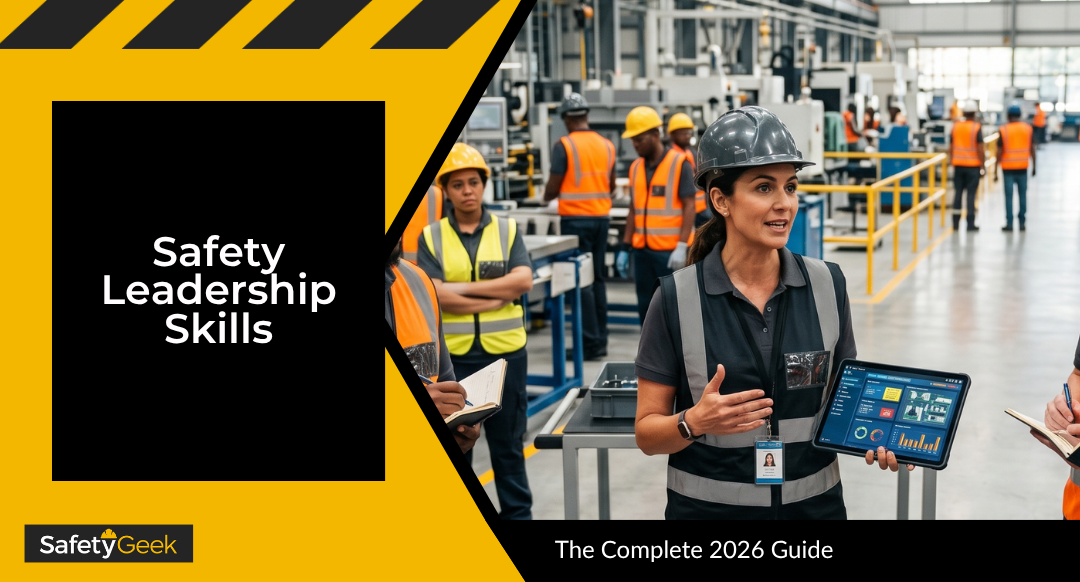
TL;DR: Safety leadership skills are the competencies that let safety professionals drive culture, influence decisions, and get results without formal authority. The five that matter most: influence and persuasion, coaching front-line supervisors, risk-based decision making, strategic communication, and business acumen. Regulations are the C grade. What moves the needle is how you lead people, build trust with executives, and design systems that make the safe way the easy way. This guide breaks down each skill and links to deeper playbooks for every one.Safety leadership skills are the set of people-focused, systems-focused, and business-focused competencies that turn a safety manager into a safety leader. They include influence without authority, coaching supervisors, risk-based decision making, strategic communication, data storytelling, and business acumen. Without these skills, the best safety program still gets ignored. Here’s the thing most of us were never told… safety school teaches regulations. The job requires leadership. You can know every line of 29 CFR 1910 and still watch your program stall because you haven’t learned how to get a plant manager to change his mind, how to coach a supervisor instead of fixing the problem yourself, or how to translate an injury trend into dollars the CFO actually cares about. That’s the gap this guide closes.
Table of Contents
- What Are Safety Leadership Skills?
- Why Safety Leadership Skills Matter More Than Regulations
- Skill 1: Influence Without Authority
- Skill 2: Coaching Front-Line Supervisors
- Skill 3: Risk-Based Decision Making
- Skill 4: Strategic Communication
- Skill 5: Business Acumen and Data Storytelling
- How to Develop Safety Leadership Skills
- Safety Management Best Practices That Build Leadership
- Frequently Asked Questions
Key Takeaways
- Safety leadership is influence, not authority. You rarely have hire-fire power, so you have to lead through the chain of command, not around it.
- The best safety leaders coach supervisors to own compliance rather than playing safety police themselves.
- Risk-based decision making is how you shift from reacting to incidents to preventing them at scale.
- Business acumen is non-negotiable. If you can’t translate safety into dollars, operations, and quality, you’ll always be a cost center in executives’ eyes.
- Communication style matters as much as content. Talk to executives about profit, managers about efficiency, and employees about their daily experience.
- Culture is always created from the top. Bottom-up safety culture is a myth – you influence leadership, and leadership shapes everyone else.
- Career advancement follows skill-building. Standing out as a safety professional is a byproduct of systems mastery, influence, and strategic thinking.
What Are Safety Leadership Skills?
Safety leadership skills are the competencies that allow a safety professional to drive results through other people rather than doing the work themselves. They sit at the intersection of three disciplines: occupational safety knowledge, people leadership, and business strategy. A safety manager with strong technical knowledge but weak leadership skills tends to become a “team of one” – overworked, unheard, and eventually burned out. The five core safety leadership skills every safety professional needs to master:| Skill | What It Looks Like | Why It Matters |
|---|---|---|
| Influence Without Authority | Moving decisions through persuasion, data, and relationships | Safety rarely has hire-fire power |
| Coaching Supervisors | Teaching front-line leaders to own compliance | You can’t be everywhere at once |
| Risk-Based Decision Making | Prioritizing controls by likelihood and severity | Resources are always finite |
| Strategic Communication | Tailoring messages to executives, managers, and employees | Different audiences need different framing |
| Business Acumen | Translating safety into ROI, efficiency, and quality | Executives make decisions in dollars |
Why Safety Leadership Skills Matter More Than Regulations
Regulations are the C grade. They take roughly a decade to become law, get watered down through lobbying, and by the time they pass they’re barely minimum. They’ll keep you out of legal trouble. They will never get you to zero. What actually keeps people safe is psychology, marketing, and the leadership skills that let you apply both at scale. The National Safety Council estimated that work-related deaths and injuries cost the nation nearly $1.2 trillion in 2022, and Liberty Mutual’s 2025 Workplace Safety Index pegs direct workers’ comp costs at more than $1 billion per week. Regulations alone aren’t closing that gap. Leadership is. And here’s what I’ve seen play out in facility after facility… the programs that survive leadership changes, market downturns, and new plant managers are the ones built on influence and systems, not on one safety manager’s willpower. When safety is baked into how supervisors lead, how executives make capital decisions, and how employees talk about their own work – that’s durability. That’s also where career opportunity lives. Safety is one of the few professions where you can advance from hourly worker to director without a four-year degree, but only if you build the leadership skills.Skill 1: Influence Without Authority
Influence without authority is the ability to get decisions, resources, and behavior change from people who don’t report to you. For safety professionals, this isn’t a nice-to-have. It’s the entire job. You sit outside the line of power. You don’t hire, fire, or promote. And yet you’re expected to shift behavior across every department. The five things that build real influence:- Know, Like, and Trust – every positive interaction is a deposit you can draw from later
- Operational expertise – people listen to safety leaders who understand the work
- Data that tells a story – numbers without narrative don’t move anyone
- Business framing – tie safety decisions to outcomes the other person cares about
- Consistency over time – short-term influence campaigns fade; trust compounds
Skill 2: Coaching Front-Line Supervisors
Coaching front-line supervisors is the skill of transferring safety ownership from the safety department to the people who actually lead the work. Safety compliance belongs to supervisors, not to you. Your job is to make them successful at it. The mindset shift here is hard for many safety managers. You came up solving problems. You’re good at it. So when a supervisor asks for help, your instinct is to take the task off their plate. Every time you do, you reinforce the belief that safety is your job, not theirs – and you guarantee that when you’re out of the room, nothing happens. A supervisor-centered coaching conversation looks like this:- Ask what they’re seeing, not what they need you to fix
- Name the safety principle at play (hazard recognition, control selection, accountability)
- Offer two or three options, not an answer
- Let them choose and own the follow-through
- Circle back, acknowledge what worked, and help them refine
Skill 3: Risk-Based Decision Making
Risk-based decision making is the discipline of prioritizing safety resources by the likelihood and severity of potential loss, rather than by whoever yelled loudest. It’s how you shift from reactive firefighting to strategic prevention. And it’s a leadership skill, not a technical one, because the hard part isn’t the math – it’s defending your priorities when operations wants something else. A simple risk-based framework has four steps:- Identify hazards through JHAs, incident data, and employee reports
- Assess each hazard by likelihood and severity
- Control using the hierarchy of controls (elimination first, PPE last)
- Verify that controls are working through observations and data
Skill 4: Strategic Communication
Strategic communication is tailoring your message to the person in front of you so it lands with impact. The same safety issue gets framed three different ways depending on who’s listening. Talk to executives about dollars and profit. Talk to managers about efficiency and quality. Talk to employees about their daily experience. One message for all three audiences is a message that reaches none of them. Quick comparison of how to frame the same recordable injury to three audiences:| Audience | Framing | Key Message |
|---|---|---|
| Executives | Financial impact | “This injury cost us $72K direct and an estimated $216K indirect – here’s how we stop the next one.” |
| Operations Managers | Productivity and quality | “We lost 14 production hours and three quality holds from this event. The fix also improves throughput.” |
| Front-line Employees | Personal experience | “This is the second time this month someone got hurt on this task. Here’s what we’re changing so you go home whole.” |
THE ALL-ACCESS PASS RESOURCE PAGE
Get all the FREE templates, safety management resources, PDFs, spreadsheets, and more...
Skill 5: Business Acumen and Data Storytelling
Business acumen is the ability to connect safety decisions to the financial, operational, and strategic outcomes the business cares about. It’s what turns safety from a cost center into a profit center in the eyes of leadership. Every dollar saved in workers’ comp, insurance premiums, downtime, turnover, and quality rework is a dollar earned – but only if you can show it. The three numbers every safety leader should know cold for their facility:- Total Recordable Injury Cost (direct + indirect, rule of thumb is 3x-5x direct)
- Workers’ Comp Experience Modifier and what a 0.1 reduction is worth annually
- Cost per production hour lost to safety events
How to Develop Safety Leadership Skills
Safety leadership skills are built through deliberate practice, targeted study, and real-world application – not through certifications alone. CSP, OHST, and ASP matter for credibility. They don’t teach you to lead. That part is on you. The playbook I teach in the Safety Leadership Academy has five pillars:- Study outside the safety lane – pick up books on influence, behavioral psychology, sales, and marketing. The best safety leaders I know have read more Cialdini than OSHA.
- Build relationships before you need them – get to know supervisors, managers, and executives as people first
- Practice the uncomfortable conversation – the ones where you push back, disagree, or ask for resources
- Track your own leading indicators – how many coaching conversations, leadership touchpoints, and business-framed presentations per month
- Invest in continuing education – a common benchmark is 5-15% of your annual salary in self-development
Safety Management Best Practices That Build Leadership
The daily practices of top safety leaders look surprisingly ordinary – but they compound into outsized results. These are habits, not heroic moments. They’re what separate a safety manager who plateaus from one who keeps getting promoted. Core best practices that build leadership muscle:- Start every week with the top three risks and a plan for each
- Run weekly one-on-ones with operations leadership focused on business outcomes, not safety updates
- Walk the floor daily with a specific observation focus, not a generic walkthrough
- Coach in the moment when you see a supervisor get something right – positive reinforcement beats correction
- Close the loop on every employee safety suggestion within seven days
- Prepare a one-page monthly safety business review that speaks in dollars, efficiency, and quality
Frequently Asked Questions About Safety Leadership Skills
What are the most important safety leadership skills?
The five most important safety leadership skills are influence without authority, coaching front-line supervisors, risk-based decision making, strategic communication, and business acumen. Technical safety knowledge is the foundation, but these five are what separate safety managers from safety leaders and drive real culture change across the organization.How are safety leadership skills different from safety management skills?
Safety management skills focus on running the program – writing policies, tracking training, managing inspections. Safety leadership skills focus on influencing people, decisions, and culture across departments you don’t control. Management is about the program. Leadership is about the people who make the program work. You need both, but leadership is what gets you promoted.Do I need formal authority to be a safety leader?
No. Most safety professionals have little to no formal authority, and that’s actually a strength once you embrace it. You’re forced to develop influence, persuasion, and relationship skills that colleagues with authority rarely build. Working through the chain of command – rather than around it – makes your impact more durable because it doesn’t depend on your title.How do I develop safety leadership skills without a formal program?
Start with three moves: read one book per month outside of safety (influence, psychology, business strategy), schedule weekly one-on-ones with a supervisor or manager to coach rather than audit, and build a monthly business-framed safety review you can present to leadership. Structured programs like the Safety Leadership Academy accelerate the curve, but you can start today.What’s the biggest mistake safety managers make as leaders?
Trying to do everything themselves. The “team of one” badge of honor is actually a leadership failure – it means you haven’t built the systems and coached the supervisors needed for safety to function without you. If your program collapses the week you take vacation, you don’t have a program. You have a personality cult.How does leadership differ for a new versus experienced safety professional?
New safety professionals should focus on technical credibility first – learn the regulations cold, build strong JHAs and SOPs, and run excellent training. That earns you the right to lead. Experienced safety professionals should shift their focus almost entirely to coaching, strategy, and business influence. The leadership ratio should tilt more toward influence as you advance.What role does data play in safety leadership?
Data is how you earn a seat at the executive table. Leading indicators, cost-of-risk calculations, and trend analyses let you speak in the language of business. Without data, you’re offering opinions. With data, you’re offering decisions. Every top safety leader I know has a dashboard they can pull up in thirty seconds to answer any executive question.Now It’s Your Turn
Safety leadership skills are what turn a safety manager into a safety leader – influence, coaching, risk-based thinking, strategic communication, and business acumen. Build those five and you stop chasing compliance. You start shaping culture. Pick your starting point this week:- Identify one supervisor to coach weekly instead of managing tasks for
- Translate your top three risks into dollar figures and put them on a one-page executive summary
- Book a 30-minute one-on-one with an operations leader – listen twice as much as you talk
- Pick up one book on influence or behavioral psychology this month
- Audit your own leading indicators – coaching conversations, leadership touchpoints, business-framed presentations
Hi, I'm Brye (rhymes with sky)! I am a self-proclaimed safety geek with two decades of general industry safety experience. Specializing in bringing safety programs to a world-class level and building a safety culture, I have trained and coached many safety managers, just like you, on how to effectively manage workplace safety in the real world. I would love to help you too.