Estimated Reading Time: 9 minutes
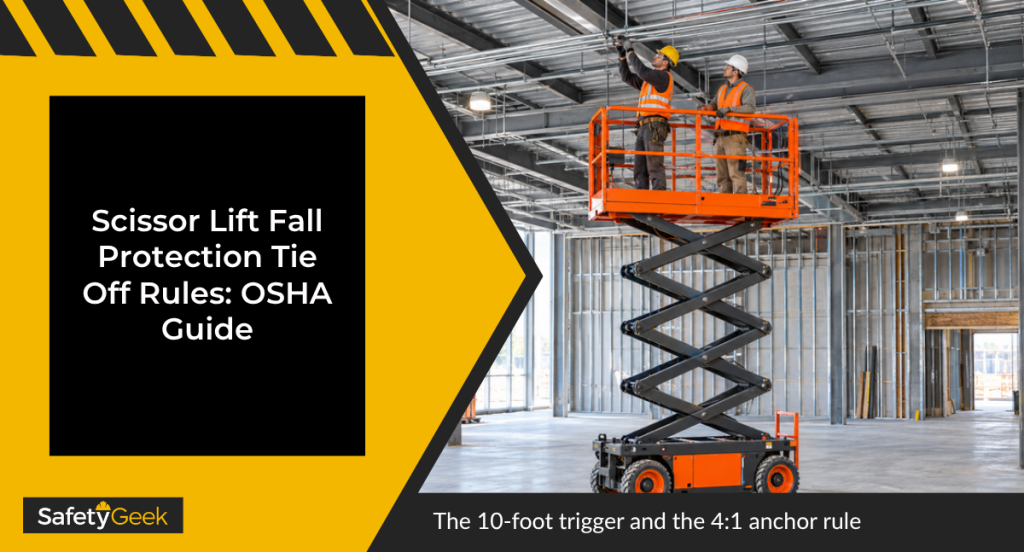
TL;DR: On a scissor lift in construction, OSHA lets you choose guardrails or a personal fall arrest system once the platform is more than 10 feet up. If the guardrails are solid and everyone stays on the platform, OSHA doesn’t require a harness. Boom lifts are different, because they do require tie-off. Your site can still require 100% tie-off, and that rule has to apply to everyone.
Scissor lift fall protection tie-off rules under OSHA boil down to 1 question: are the guardrails doing the job? If the guardrails meet the scaffold standard and the worker stays on the platform, OSHA doesn’t require tie-off. Leave the platform or lose the rails, and you need something else.
But “OSHA doesn’t require it” is only half the answer.
Say the general contractor announces that everyone clips in on lifts, and the whole crew turns to look at you. “OSHA requires it” is wrong. “It’s not required” sounds like you don’t care.
A harness can be a legal requirement, a site rule, or a manufacturer instruction, and those aren’t the same thing. The legal question has a short answer. The harder one is why a good supervisor might still skip it, and we’ll get to that.
Key Takeaways
- OSHA treats a scissor lift as a scaffold. That’s why the tie-off rules differ from a boom lift’s.
- Above 10 feet, you need guardrails or a personal fall arrest system. The employer chooses.
- Good guardrails and a worker who stays on the platform mean no tie-off is required. OSHA has said so in writing.
- Leaving the platform, missing rails, or standing on the rails changes the answer.
- Never attach fall arrest gear to the guardrails. Use the lift’s own anchor point or an adjacent structure.
- A 100% tie-off rule is a site rule. It’s legal to require it, and it only works if supervisors follow it too.
What OSHA Requires for Fall Protection on a Scissor Lift
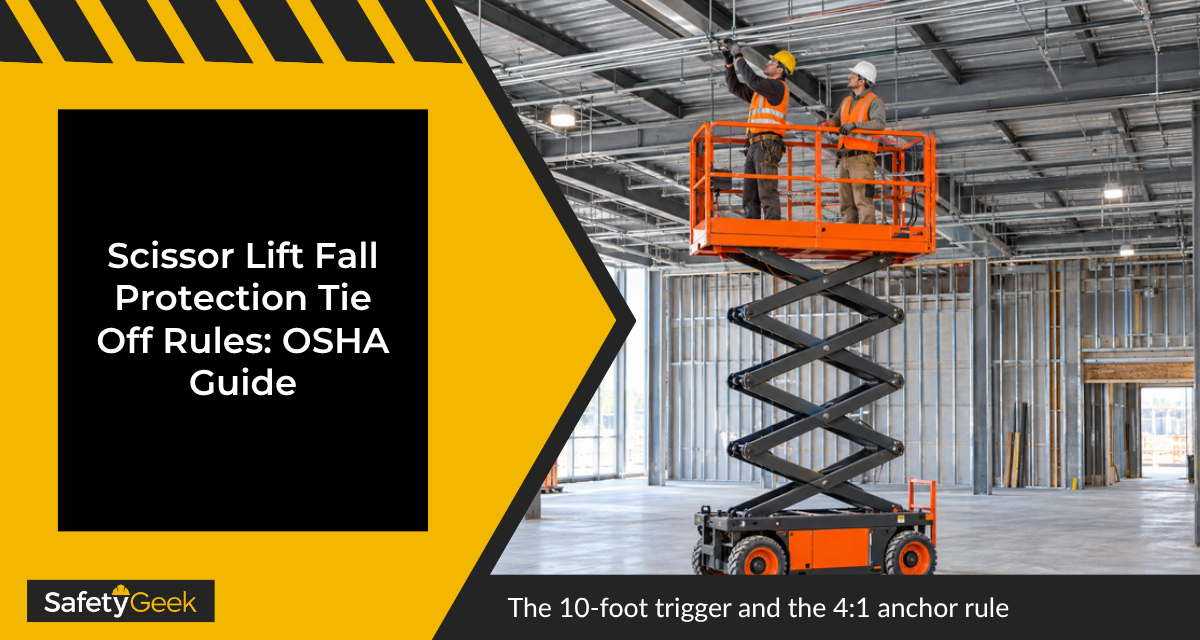
In construction, OSHA treats a scissor lift as a type of scaffold. The aerial lift standard, 29 CFR 1926.453, applies to the equipment listed in the 1969 ANSI A92.2 standard, such as extensible booms, aerial ladders, and vertical towers. Scissor lifts aren’t in that list, so OSHA says the scaffold standard in 1926.451 covers them instead, according to its 2000 letter on fall protection for lifts.
Once a worker is more than 10 feet above a lower level on a scaffold, the worker must be protected from falling. For a scissor lift, paragraph (g)(1)(vii) says the protection is a personal fall arrest system or a guardrail system that meets (g)(4).
The employer picks which one. Nothing in the standard says a worker inside a guarded platform must also wear a harness.
Scissor Lifts and Boom Lifts Follow Different Rules
This is where most of the confusion starts. A crew moves from a boom lift to a scissor lift in the same week, and the tie-off habit follows them.
| Scissor Lift | Boom Lift or Aerial Lift | |
|---|---|---|
| OSHA standard | Scaffold standard, 1926.451 | Aerial lift standard, 1926.453 |
| Fall protection | Guardrails or a personal fall arrest system | Tie-off required |
| Harness with good guardrails? | Not required by OSHA | Required |
| Fall protection trigger | More than 10 feet | Whenever workers are in the basket |
OSHA’s 2000 letter says it plainly: workers in aerial lifts and boom-type platforms must be tied off, while workers on scissor lifts must be tied off or protected by guardrails. Same trade, same site…different rule.
The 10-Foot Trigger
Wait, isn’t it 6 feet? That’s the number most of us carry around from general construction fall protection.
The 10-foot line comes from the scaffold standard, and it’s measured from the platform to the lower level. Our guide to the OSHA 10-foot rule for scaffold fall protection walks through why those 2 numbers get mixed up.
When Guardrails Are Enough, and When They Aren’t
A properly designed and maintained guardrail system is enough fall protection on a scissor lift. OSHA’s 2005 interpretation letter answered a direct question about workers on a guardrail-equipped scissor lift platform that extends past the wheelbase, working while the lift is stationary. Do they have to tie off?
No, because the employer can use either a fall arrest system or a guardrail system that meets 1926.451(g)(4).
That answer comes with a condition OSHA repeats from an earlier letter. If the guardrail system is less than adequate, or the worker leaves the safety of the work platform, an additional fall protection device is required. So the real question on the lift is whether those 2 conditions are true right now.
3 Times Guardrails Stop Being Enough
- The rails aren’t adequate. A missing midrail, a gate that doesn’t latch, or a bent top rail all count. Our guide to guardrail height and strength specs lists what passes inspection.
- The worker leaves the platform. Stepping onto a slide-out deck or out onto a structure takes the worker beyond the protection of the rails. If the worker is stepping onto an edge, the unprotected sides and edges rules apply as well.
- The worker stands on the guardrail. OSHA’s 2002 letter on standing on lift guardrails says no single provision bans it, but, in practice, the scaffold requirements can’t be met. The rail would become a scaffold platform, and it wasn’t designed to carry that load. A worker standing on the top rail with a lanyard clipped to that same rail has neither a platform nor an anchor.
Restraint vs Fall Arrest: What a Tie-Off System Has to Do
A restraint system keeps a worker from falling, and a fall arrest system stops a fall after it starts. OSHA draws that line in its 2000 letter, and it matters on a scissor lift because the two systems have very different requirements.
Positioning devices let a worker lean back and work hands-free, but they’re only for vertical surfaces. A scissor lift platform is horizontal, so they aren’t allowed.
| System | What It Does | On a Scissor Lift |
|---|---|---|
| Restraint | Keeps the worker from reaching the edge | Belt or harness. Lanyard set so no fall is possible |
| Fall arrest | Stops a fall already in progress | Full body harness only. The lift must handle the arrest forces |
| Positioning | Supports a worker on a vertical surface | Not allowed |
What Fall Arrest on a Lift Requires
Fall arrest on a scissor lift comes with a few rules you can’t skip. The anchor can’t be the guardrail, because 1926.502(d)(23) prohibits attaching a personal fall arrest system to a guardrail system. It has to be the lift itself or an adjacent structure.
If you anchor to the lift, the lift has to be able to sustain the load of an arrested fall with a 4:1 safety factor, per OSHA’s 2002 letter. The rescue provision in 1926.502(d)(20) also applies, so you need a plan to get a hanging worker down fast. Start with our guide to a suspension trauma rescue plan.
Why Restraint Is Usually the Cleaner Choice
When a rule calls for tie-off on a lift, restraint avoids most of that. OSHA’s 2000 letter says the rescue provision doesn’t apply when the lanyard is set so the worker can’t be exposed to a fall (and nobody needs a rescue plan for a fall that never happens). You also skip the question of whether the lift can take an arrest load.
Whichever system you choose, check the equipment against the personal fall arrest system equipment criteria before it goes up on the lift.
THE ALL-ACCESS PASS RESOURCE PAGE
Get all the FREE templates, safety management resources, PDFs, spreadsheets, and more...
When Your Site Requires 100% Tie-Off
OSHA sets the minimum, and an employer or general contractor can require more. Plenty of general contractors require 100% tie-off on every lift, even when the guardrails meet the standard. That’s a legitimate site rule, and workers can be held to it.
Let’s be honest: “OSHA requires it” is wrong for a guarded scissor lift, and the first worker who looks it up will STOP believing the rest of what you tell them. “This site requires it” is true, and it’s enough.
Use the Anchor Point the Lift Gives You
Check what your lift’s manufacturer says. Genie’s operator’s manual for the GS-2032 and GS-2632 says the guard rail system provides fall protection. If job site or employer rules require personal fall protection equipment, follow that equipment maker’s instructions and use the approved lanyard attachment point provided.
Your model may be different. Read the manual and the decals on your own lift, because they tell you which point is approved and what it’s rated for. And never assume a platform anchor is approved for use once the worker leaves the platform.
The Rule Has to Apply to Everyone
Here’s a story from a company I worked for. At a location I wasn’t over, a supervisor who trained others on fall protection climbed warehouse racking without any fall protection and fell to his death.
It wasn’t the first time he’d done it. Everyone knew he climbed. It was allowed; it was tolerated…until the day it killed him.
That was racking, not a lift, but swap one for the other and the question is the same: who gets to decide the rule doesn’t apply to them? If your site rule says tie off, the foreman, the superintendent, and the safety lead clip in too.
So why does a good supervisor skip a rule he teaches? The same reason anybody does: it’s been done a hundred times, and nothing happened. Once the person with the title does it, the crew learns the rule is optional.
And when someone gets hurt on a site rule you wrote, you’re one of the first people asked how it was enforced.
Build Scissor Lift Fall Protection Into Your Program
Scissor lift fall protection works when somebody decides before the lift goes up. The aerial lifts fact sheet from the Center for Construction Research and Training reports 1,450 construction workers injured and 142 killed while operating an aerial lift between 2011 and 2016, and those numbers aren’t limited to scissor lifts.
The Safety Management Cycle turns the rules above into something your crews can follow:
- Identify: List every task done from a lift, and mark where a worker would step off the platform or work near an edge.
- Develop: For each task, decide whether it needs guardrails only, restraint, or fall arrest. Write 1 line into the procedure.
- Implement & Train: Show operators the approved anchor point on the actual lift. Cover the 3 times guardrails stop being enough.
- Coach & Observe: Supervisors watch for standing on rails, leaving the platform, and attaching to guardrails.
- Analyze: Trend what the observations show, then adjust the procedure.
Frequently Asked Questions About Scissor Lift Tie-Off
Do you have to tie off in a scissor lift?
Not under OSHA, if the guardrails meet the scaffold standard and the worker stays on the platform. OSHA has said the employer can use guardrails or a personal fall arrest system. Your site, your company, or the manufacturer may still require a harness, so check those rules too.
Can you tie off to the guardrail of a scissor lift?
No, because 1926.502(d)(23) prohibits attaching a personal fall arrest system to a guardrail system. Anchor to the lift’s approved attachment point, if the manufacturer provides one, or to an adjacent structure. Anchoring to the lift requires that it can sustain an arrested fall with a 4:1 safety factor.
What is the difference between scissor lift and boom lift tie-off rules?
Boom lifts and other aerial lifts fall under 1926.453, which requires workers to be tied off. Scissor lifts fall under the scaffold standard, 1926.451, which allows guardrails or a personal fall arrest system. A crew working both needs to know the rule for each machine.
Can a worker stand on a scissor lift guardrail if tied off?
OSHA says no single provision bans it, but in practice the scaffold requirements can’t be met. The guardrail would become a scaffold platform, and rails aren’t built for that load. A harness doesn’t fix it, and you can’t attach fall-arrest gear to the rail.
Do scissor lifts need a rescue plan for fall arrest?
Yes, if you use fall arrest, because the rescue provision in 1926.502(d)(20) applies. It doesn’t apply when a restraint system is set so the worker is never exposed to a fall. Either way, plan before the lift goes up.
Now It’s Your Turn
On a scissor lift, guardrails are the default, and you add tie-off when the guardrails stop doing the job.
Here’s where to start this week:
- Check every scissor lift’s guardrails, gate, and midrail against the guardrail specs.
- Find the approved lanyard attachment point on each lift, and read what the manual says it’s for.
- Write 1 line for your procedure: guardrails only, restraint, or fall arrest, and who decides.
- If your site requires tie-off, ask your supervisors if they clip in every time. Then fix whatever made it easy to skip.
- If you use fall arrest, confirm the rescue plan exists on paper and on site.
You can write the rule all day, and it’s still just another piece of paperwork until supervisors own it…does that sound like your week? You can’t be at every lift.
John Lange, an EHS Supervisor in beverage manufacturing, built a plan inside the Safety Leadership Academy to “remove the do-it-all load placed on myself” and have supervisors “lead the front line charge.” Different industry, same problem: it can’t all land on you.
My free training on the Safety Influencer System shows you how to get there. It’s the same thinking we teach in the Academy.
You got this, my safety friend.
Hi, I'm Brye (rhymes with sky)! I am a self-proclaimed safety geek with two decades of general industry safety experience. Specializing in bringing safety programs to a world-class level and building a safety culture, I have trained and coached many safety managers, just like you, on how to effectively manage workplace safety in the real world. I would love to help you too.