Estimated Reading Time: 8 minutes
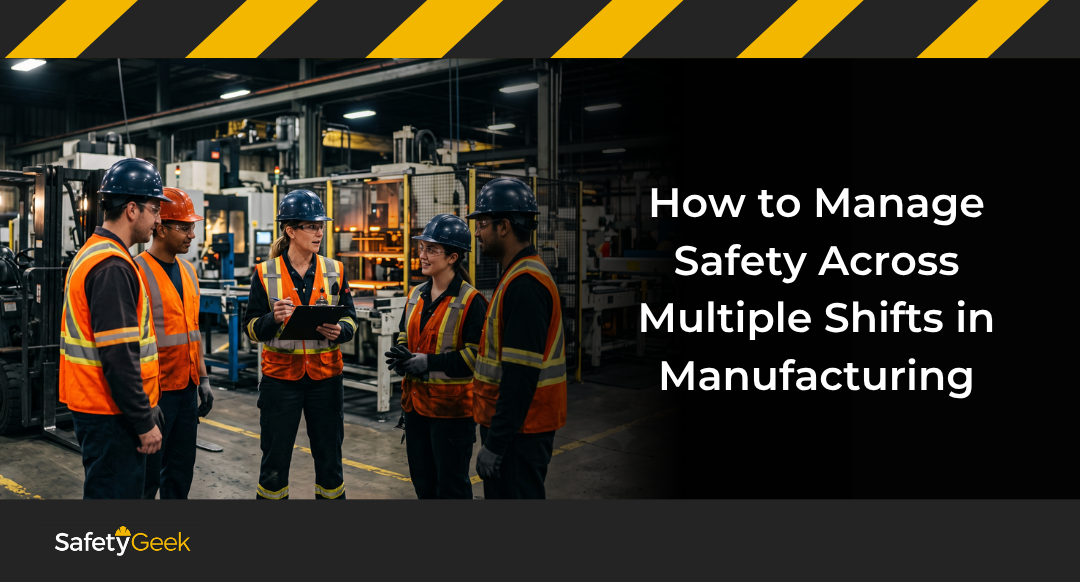
To manage safety across multiple shifts in 24/7 manufacturing operations, stop relying on your presence and start building systems that run without you. Give every shift a trained supervisor who owns safety, a standardized handover that passes open hazards forward, and per-shift leading indicators you can actually see. Consistency comes from how you design the program, not from how many hours you walk the floor.
You manage safety across multiple shifts in 24/7 manufacturing operations by building systems that hold the same on Tuesday at 2 PM as they do on Saturday at 2 AM. That means a supervisor who owns safety on every shift, a handover that moves open hazards forward, and data you collect shift by shift. Your job isn’t to be everywhere… it’s to design a program that doesn’t fall apart the moment you go home.
Here’s the part most safety leads feel but rarely say out loud. You can run a tight program on days and still have no clue what happens once you leave.
The night crew relaxes. The weekend shift does it their own way. And you find out something went sideways on Monday morning, when it’s already too late to do anything but investigate.
Key Takeaways
- Presence doesn’t scale, but systems do. You can’t out-walk a 24/7 operation, so the program has to run without you on the floor.
- The night shift is the highest-risk shift. Fatigue, thinner supervision, and circadian disruption all stack against your off-shift crews.
- Every shift needs an owner. A trained supervisor on each shift has to own safety the same way they own production.
- The shift handover is a safety control. A standardized, documented handover keeps open hazards from disappearing between crews.
- Measure each shift separately. Per-shift leading indicators expose problems that annual averages hide completely.
- Consistency is designed, not enforced. When a process is easy to follow on every shift, the culture holds no matter who is watching.
Why Multi-Shift Safety Falls Apart on Nights and Weekends
Multi-shift safety breaks down because your off-shifts run with less supervision, more fatigue, and almost no leadership presence. The same hazards exist at 2 AM as they do at 2 PM, but the people watching for them are tired and stretched thin. That gap is where incidents happen.
The research backs up what every safety lead already senses. According to NIOSH’s research on shift work and long work hours, night and rotating shifts carry a higher risk of injury than day shifts, mostly because of sleep loss and circadian disruption. Fatigue slows reaction time, dulls decision-making, and quietly chips away at attention right when a forklift or a press demands all of it.
It gets worse the longer the shift runs. OSHA’s guidance on extended and unusual work shifts points out that shifts longer than eight hours reduce alertness and productivity, and it tells employers to actively watch workers for signs of fatigue. So your 12-hour night crew is fighting biology and the clock at the same time.
And here’s the trap I see over and over. Most facilities track one injury rate for the whole plant. You can pull a clean total recordable rate from the Bureau of Labor Statistics injury data for manufacturing and feel good about it, while your night shift is quietly running three times higher. One blended number hides the shift that’s actually bleeding.
This is the same problem you hit when you’re managing a safety team of one. You physically cannot cover every hour, so the question stops being “how do I get to the night shift more” and becomes “how do I build a program that protects the night shift without me there.”
Build Safety Systems That Hold Without You There
The fix for multi-shift safety isn’t more of your hours. It’s a system that runs the same on every shift, owned by the people who are actually there. Your role is the guide on the side, not the cop walking the floor at midnight.
Start with ownership. Every shift needs a supervisor who owns safety the way they own throughput, and that means putting your frontline supervisors in charge of safety compliance. They’re in the employee’s line of power, they’re there all shift, and the crew already answers to them. You train them, give them the tools, and hold them to the same standard regardless of which shift they run.
Then give them a repeatable rhythm. The Safety Management Cycle gives each shift the same five steps to run on their own: Identify hazards, Develop controls, Implement and Train, Coach and Observe, and Analyze the results. When the night supervisor runs the exact same cycle as the day supervisor, the program stops depending on who happens to be awake.
This is also a mindset shift. When the same mistake keeps showing up on nights, the instinct is to blame the night crew. But the Systems, Not People principle says the opposite… if a whole shift keeps cutting the same corner, the system is making it hard to do right, not the people choosing to do wrong.
Here’s the difference in plain terms:
| Presence-Based Safety | System-Based Safety |
|---|---|
| Safety happens when you’re on the floor | Safety runs on every shift without you |
| Night shift waits for you to catch problems | Night supervisor owns and closes problems |
| You find out about hazards on Monday | Hazards move forward at every handover |
| One blended injury rate for the plant | Leading indicators tracked per shift |
| Culture changes when leadership is watching | Culture holds because the process is easy to follow |
The supervisors carrying this don’t need a lecture once a quarter. They need short, repeatable coaching moments built into their week, which is exactly what mini coaching sessions are built for. Small and consistent beats big and occasional every time.
THE ALL-ACCESS PASS RESOURCE PAGE
Get all the FREE templates, safety management resources, PDFs, spreadsheets, and more...
Turn the Shift Handover Into a Safety Control
A shift handover is the moment one crew passes responsibility and information to the next. In a 24/7 plant, it’s also the single biggest point where safety information gets lost. Treat it like a safety control, not a hallway chat on the way out the door.
Most handovers fail because they’re informal and rushed. The outgoing operator mentions the sticky guard or the half-finished lockout in passing, the incoming operator half-hears it over the line noise, and by 3 AM nobody remembers there was an open hazard at all. That’s how a tag-out gets missed and someone gets hurt on equipment the last shift knew was bad.
So build structure into it. A strong safety handover passes along a short, standard set of items every single time, no matter who is running the shift:
- Open hazards and near misses from the shift, with what was done about them
- Active lockout/tagout and permits still in place or pending
- Equipment status for anything damaged, bypassed, or running rough
- Incomplete tasks that carry safety risk if picked up wrong
- Anything that changed in the area, like a new chemical, a repair, or a layout shift
Give it a few minutes of paid overlap so it actually happens face to face. A simple structure helps here, even borrowing the SBAR format used in healthcare: Situation, Background, Assessment, Recommendation. Write it down too, because a digital or paper log creates a trail you can audit and trend later.
And audit it. Walk a non-day shift now and then and ask the incoming supervisor what came across at handover. If they can’t tell you, the handover is broken… and that’s a system fix, not a people problem.
Measure Safety One Shift at a Time
You can’t manage what you can’t see, and a single plant-wide injury rate hides almost everything that matters across shifts. The fix is per-shift leading indicators, measured separately for days, evenings, and nights. That’s how you spot the shift that’s drifting before it turns into a recordable.
A leading indicator is a proactive measure of the safety activity happening now, before anyone gets hurt. Lagging indicators like injury counts only tell you what already went wrong. If you want the full breakdown of the difference, it’s worth understanding how to use safety leading indicators to drive behavior instead of just counting bodies.
For a multi-shift operation, track these by shift and compare them side by side:
- Pre-shift safety talks completed and documented per shift
- Near-miss reports submitted per shift, plus how fast they get closed
- Supervisor safety walks done on each shift, especially nights and weekends
- Observations and coaching moments logged per shift
- Handover completion and the open items carried forward
Watch the contrast between shifts, not just the totals. If your night shift reports zero near misses month after month, that’s not a safe shift… that’s a silent one, and silence is the scariest data point you’ll ever read. When you build a data-driven safety program that breaks numbers down by shift, the problem shift can’t hide behind the plant average anymore.
Frequently Asked Questions About Multi-Shift Safety
Why is the night shift more dangerous than the day shift?
Night shifts fight against the body’s natural sleep cycle, which slows reaction time and dulls decision-making. They also tend to run with fewer supervisors and less leadership presence. NIOSH research links night and rotating shifts to higher injury rates, mostly from fatigue and sleep loss.
How do I keep safety consistent when I can’t be there at night?
Build a system that doesn’t depend on you. Put a trained supervisor in charge of safety on every shift, run the same Safety Management Cycle across all shifts, and standardize the handover. Consistency comes from a repeatable process, not from how many hours you personally walk the floor.
What should a safety shift handover include?
A safety handover should pass along open hazards and near misses, active lockout/tagout and permits, equipment status, incomplete high-risk tasks, and anything that changed in the area. Give it a few minutes of paid overlap so it happens face to face, and document it so you can audit and trend it later.
How do I hold the night shift accountable for safety?
Accountability starts with a shift supervisor who owns safety inside their line of power. Track per-shift leading indicators so each shift’s activity is visible, then coach against that data. When several people on one shift make the same mistake, fix the system making it hard, not just the individuals.
What safety metrics should I track for each shift?
Track leading indicators per shift: completed pre-shift talks, near-miss reports and how fast they close, supervisor safety walks, logged observations, and handover completion. Comparing these across days, evenings, and nights reveals the drifting shift long before it shows up in your injury numbers.
Now It’s Your Turn
Managing safety across multiple shifts comes down to one shift in thinking. Stop trying to be everywhere, and start building a system that protects every shift whether you’re there or not.
Here’s where to start this week:
- Pick your highest-risk shift, usually nights, and walk it this week. See what actually happens when you’re not normally there.
- Name a safety owner on every shift and tell them plainly that safety is theirs, the same as production.
- Build a one-page handover checklist with open hazards, lockout/tagout, and equipment status, and require a few minutes of overlap.
- Pick two leading indicators and start tracking them per shift so you can compare days against nights.
The Safety Management Cycle is the backbone that lets every shift run the same program without you in the room. If you want to learn how to run your whole program through that recurring cycle, the free course inside the Safety Geek Stash walks you through it step by step. It’s the same system we build out with safety leads inside the Safety Leadership Academy.
You don’t need to clone yourself to keep the night shift safe. You just need a system that holds when you go home. You got this.
Hi, I'm Brye (rhymes with sky)! I am a self-proclaimed safety geek with two decades of general industry safety experience. Specializing in bringing safety programs to a world-class level and building a safety culture, I have trained and coached many safety managers, just like you, on how to effectively manage workplace safety in the real world. I would love to help you too.