Estimated Reading Time: 8 minutes
TL;DR: Automated SDS management software pays for itself by cutting the hours your team spends chasing safety data sheets, lowering the risk of a HazCom citation, and keeping you audit-ready for the 30 years of records OSHA expects you to hold. Most safety teams recover the cost in under a year. Here’s how to build the financial case your management will actually sign off on.
The ROI of automated SDS management software comes down to three things: labor hours saved, OSHA penalties avoided, and the time you get back when an inspector shows up at the door. Most teams that move from binders to a digital system earn back what they spent in under a year. The work is putting those numbers on paper before you ask for the budget.
Here’s the part that stings. You already know your SDS binders are a mess… half of them are outdated, nobody can find the right sheet during an emergency, and you’re the one who takes the heat when an auditor pulls a chemical you don’t have a sheet for.
You didn’t let it slide on purpose. You’re buried, and SDS upkeep is the task that quietly sinks to the bottom of the pile every single week.
Key Takeaways
- Automated SDS software replaces binders with a searchable digital library your whole team can reach in seconds, on any device.
- The biggest ROI driver is labor – the hours you stop spending on searches, quarterly reviews, and manual chemical cross-checks.
- HazCom is one of OSHA’s most-cited standards, and a single Serious or Failure to Abate violation can run $16,550, with Failure to Abate charged per day.
- OSHA expects SDS or exposure records kept for 30 years beyond a chemical’s last use, which is brutal to manage on paper.
- National Safety Council data shows every $1 invested in injury prevention returns $4 to $6, and SDS software is one of the cleanest places to capture that return.
- The business case wins on dollars, not duty – frame SDS software as a profit protector, not a compliance expense.
What Automated SDS Management Software Actually Does
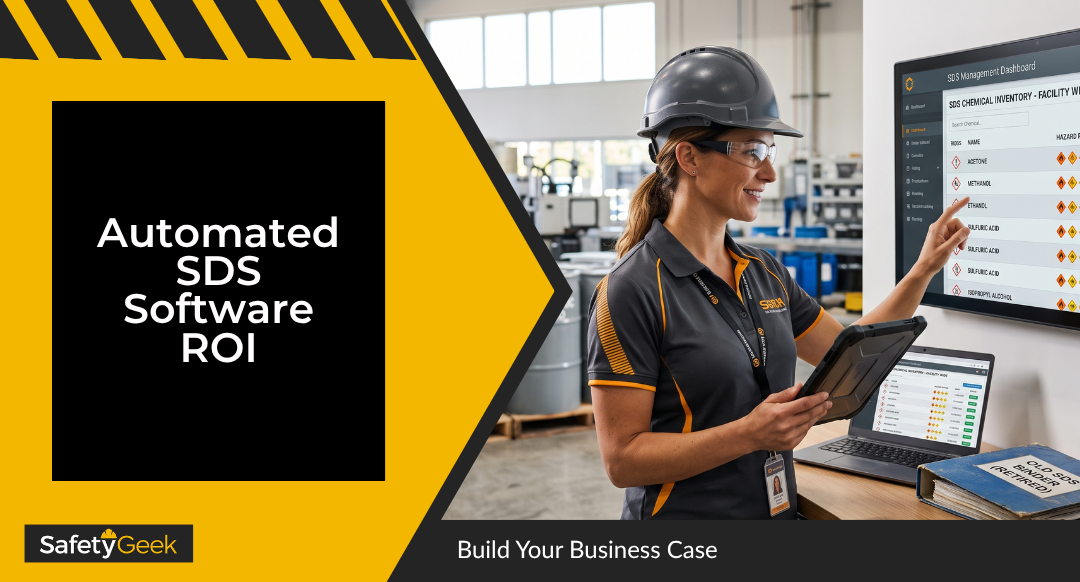
Automated SDS management software is a digital system that stores, organizes, and updates your safety data sheets in one searchable place, so any employee can pull the right sheet in seconds during a shift. It replaces the binders, the shared-drive folders, and the sticky notes with a single library that keeps itself current.
Under OSHA’s Hazard Communication Standard, you have to keep a safety data sheet for every hazardous chemical on site and make it readily accessible to employees during every shift. That sounds simple until you’re managing 800 chemicals across three buildings.
A good system does the heavy lifting for you. It cross-checks your chemical inventory against your sheet library, flags the chemicals missing a sheet, and pulls updated versions when a manufacturer changes a formulation.
It also gives you mobile access, so a maintenance tech on the far end of the plant can scan a code and read the sheet without walking back to the office. That one feature is what turns SDS access from a compliance headache into a tool people actually use.
When people can find what they need, you start building a stronger chemical safety culture instead of fighting one.
The Real Cost of Managing Safety Data Sheets by Hand
Manual SDS management is expensive in a way that never shows up on an invoice. The cost hides in your team’s hours, and those hours add up fast.
Think about what a binder system actually demands. Someone has to file new sheets, hunt down updated versions, walk the floor to confirm every chemical has a match, and physically search when an employee needs a sheet right now.
Industry guidance recommends reviewing your full SDS library four times a year. If you’ve got hundreds of chemicals, a quarterly manual review can eat days of work you don’t have.
And that’s before an emergency. When a worker splashes a chemical and the clinic needs the sheet in two minutes, flipping through a binder is the last thing you want to be doing. The cost of a slow search in that moment isn’t measured in hours… it’s measured in someone’s health.
This is the quiet drain that makes the ROI case so strong. You’re already paying for SDS management. You’re just paying for it in your team’s time, your own overwhelm, and the risk you carry every day the system stays broken.
THE ALL-ACCESS PASS RESOURCE PAGE
Get all the FREE templates, safety management resources, PDFs, spreadsheets, and more...
How to Calculate the ROI of Automated SDS Management Software
To calculate the ROI of automated SDS management software, you compare what manual management costs you each year against the price of the software, then add the penalty risk you remove. The math is simpler than it looks.
Start with labor. Estimate the hours your team spends each month on SDS searches, filing, updates, and inventory cross-checks. Multiply that by a loaded hourly rate, then by twelve.
Most teams are stunned by the number. A few hours a week across filing, searching, and quarterly reviews can easily total 150 to 250 hours a year, which is the equivalent of weeks of full-time work.
Here’s how the two approaches stack up:
| Task | Manual Binder System | Automated SDS Software |
|---|---|---|
| Finding a sheet | Minutes of searching, often unsuccessful | Seconds, by search or scan |
| Quarterly SDS review | Days of manual checking | Automated flags and alerts |
| Adding a new chemical | Manual download, print, file | Auto-pulled and indexed |
| Audit preparation | Scramble to assemble records | Records ready on demand |
| 30-year retention | Boxes, lost sheets, gaps | Permanent digital archive |
| Off-site / mobile access | None | Any device, anywhere |
Then add penalty avoidance, which we’ll break down next. When you put labor savings and risk reduction next to the subscription cost, most safety teams land on a payback period under a year. Verdantix research cited across the EHS field puts long-term software ROI well above 200 percent.
If you want a fuller model for this kind of math, our breakdown of the financial benefits of a strong safety management system walks through it step by step.
The Penalty Math: What HazCom Gaps Actually Cost
HazCom violations are not rare or theoretical. The Hazard Communication Standard is consistently one of OSHA’s most-cited standards year after year, which means inspectors know exactly where to look.
The dollars are real. Under OSHA’s penalty schedule, a Serious violation can reach $16,550, and a Failure to Abate violation is charged at up to $16,550 per day until you fix it.
A Willful or Repeated violation climbs to $165,514. Missing sheets, inaccessible binders, and outdated documents are all easy findings for an inspector to write up.
There’s a long tail too. OSHA’s access to records standard requires you to keep safety data sheets or equivalent exposure records for 30 years beyond a chemical’s last use.
Try managing three decades of paper records through office moves, software changes, and staff turnover. A digital archive doesn’t just save time today… it protects you from a gap that could surface years from now. The same logic runs through other digital safety tools and templates that swap paper for searchable records.
Building the Business Case Your Management Will Approve
Your management doesn’t approve software because it’s compliant. They approve it because the numbers make sense. So lead with the numbers.
Safety is a profit center, not a cost center. Every hour your team stops wasting on binder searches is an hour returned to the operation, and every penalty you avoid is money that stays in the budget.
Frame the request the way leadership thinks. Show the annual labor cost of manual management, the penalty exposure you’re carrying, and the payback period. Then present the software as the cheaper option, because it usually is.
This is exactly the kind of conversation we teach inside the Safety Leadership Academy… turning a safety need into a business case that executives say yes to. If buy-in is your real roadblock, our guide to winning management support for HazCom compliance gives you the exact language to use.
One more move. Tie SDS software into your existing program instead of pitching it as a standalone purchase. When it’s part of how you run the Identify and Analyze stages of your Safety Management Cycle, it stops looking like an add-on and starts looking like infrastructure.
That’s the heart of integrating your safety system with business operations, where every tool you add earns its place by moving a business metric.
Frequently Asked Questions About SDS Management Software ROI
How long until automated SDS software pays for itself?
Most safety teams reach payback in under a year. The return comes from labor hours saved on searches and reviews, plus the penalty risk you remove. When you add up manual management time against the subscription cost, the software is usually the cheaper line item within the first 12 months.
Does OSHA require SDS management software?
No. OSHA’s Hazard Communication Standard requires that safety data sheets be maintained and readily accessible to employees during every shift, but it doesn’t mandate any specific tool. Binders are legal. Software simply makes meeting the access, update, and retention rules far easier and far less time-consuming.
What’s the biggest driver of SDS software ROI?
Labor. The hours your team spends filing sheets, hunting updates, cross-checking inventory, and searching during emergencies are the single largest hidden cost of manual management. Automating those tasks returns that time to your operation, which is where most of the measurable return comes from.
How long do I have to keep safety data sheets?
OSHA’s access to records standard generally requires keeping safety data sheets or equivalent exposure records for 30 years beyond a chemical’s last use. Managing three decades of paper is difficult and risky. A digital archive keeps those records searchable and intact through staff changes and office moves.
How do I convince management to pay for SDS software?
Lead with dollars, not compliance. Show the annual labor cost of manual SDS management, the penalty exposure you carry under HazCom, and the payback period. Present the software as the cheaper, lower-risk option. Executives approve spending when the financial case is clear, so let the math do the persuading.
Now It’s Your Turn
The ROI of automated SDS management software is real, and it’s bigger than most safety teams realize once they add up the hours and the risk. The numbers are sitting in your own program right now. You just have to pull them together.
Here’s where to start this week:
- Estimate the monthly hours your team spends on SDS searches, filing, and reviews, then multiply out the annual cost.
- Pull your chemical inventory and count how many sheets are missing or outdated… that’s your current risk.
- Check OSHA’s current penalty schedule so you can show real dollars, not guesses.
- Draft a one-page business case with labor savings, penalty exposure, and payback period.
Want the system behind turning any safety need into a yes from leadership? My free Safety Management Influencer System guide shows you how to layer influence into the work you’re already doing, so management starts seeing your value automatically. It’s the same approach we build out inside the Safety Leadership Academy.
You’ve got the data. Now go make the case. You got this, Safety Friend.
Hi, I'm Brye (rhymes with sky)! I am a self-proclaimed safety geek with two decades of general industry safety experience. Specializing in bringing safety programs to a world-class level and building a safety culture, I have trained and coached many safety managers, just like you, on how to effectively manage workplace safety in the real world. I would love to help you too.